

What actually survives INT8 on the edge
A field guide to quantizing speech and vision models down to INT8 for low-power silicon: which layers break, which tricks hold, and how we measure what "good enough" means on the device itself.



Quantization is the difference between a model that runs in a datacenter and one that runs on the device in someone’s hand. The theory is simple: store weights and activations as 8-bit integers instead of 32-bit floats, and you get roughly 4x smaller, 2-4x faster, and a fraction of the power draw. The practice is where the interesting failures live.
Where INT8 breaks first
Not all layers quantize equally. In our experience the casualties are predictable:
- Attention softmax: the dynamic range of logits is brutal; naive INT8 here collapses long-range dependencies.
- LayerNorm / residual adds: small errors accumulate across depth.
- The first and last layers: input embeddings and the output head are disproportionately sensitive.
The usual fix is mixed precision: keep the sensitive layers in INT16 (or FP16) and quantize the bulk to INT8. On Qualcomm’s stack this maps cleanly onto the QAIRT graph.
Measuring on the device, not the notebook
A model that scores well on your validation set can still fall apart on the NPU, because the on-device kernels round differently than your training framework. We always close the loop on real hardware:
# Compare on-device INT8 output against the FP32 reference, per layer.
def layerwise_drift(fp32_ref, int8_dev, atol=1e-2):
    drift = {}
    for name, ref in fp32_ref.items():
        dev = int8_dev[name]
        rel = (ref - dev).abs().mean() / ref.abs().mean().clamp_min(1e-6)
        drift[name] = rel.item()
    # Flag the layers that moved the most - those are your INT16 candidates.
    return dict(sorted(drift.items(), key=lambda kv: -kv[1]))
Run that once and the layers to promote to higher precision fall out of the top of the list. It turns “quantization is an art” into a short, ranked worklist.
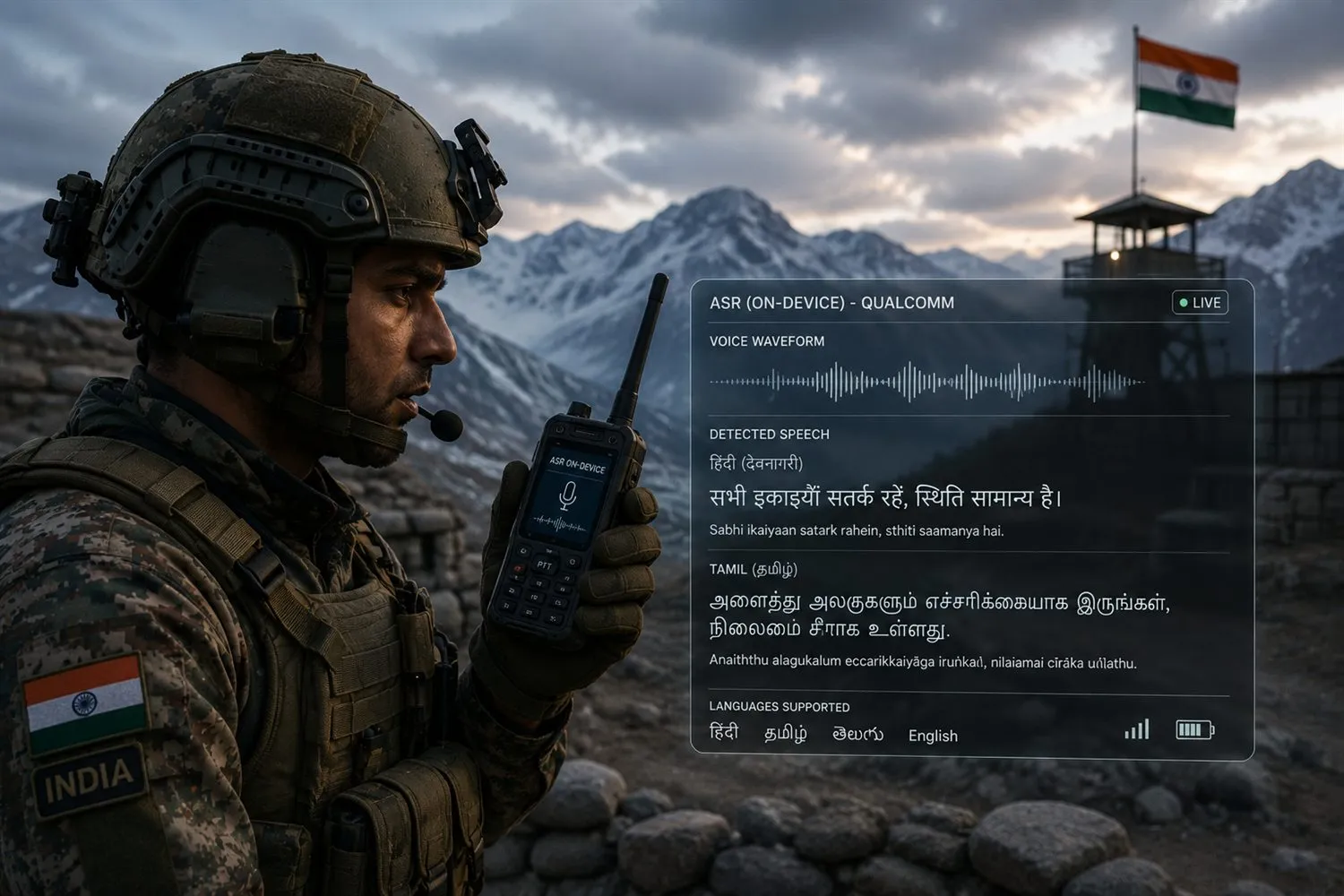
If it doesn’t run on the device, it isn’t done. A benchmark on an A100 tells you nothing about what ships.
The short version
| Technique | Cost | When it pays off |
|---|---|---|
| Post-training INT8 | Low | Vision backbones, robust CNNs |
| Mixed INT8 / INT16 | Medium | Transformers, attention-heavy models |
| Quantization-aware | High | Last mile on accuracy-critical tasks |
Start cheap, measure on-device, and only pay for QAT when the drift report says you have to. That discipline is most of the job.